
Guide
How to choose inline skate size: measuring your foot in millimetres
Choose your inline skate size by foot length in millimetres, not by shoe size. Stand with your heel against a wall, measure your longer foot to the tip of the longest toe and choose skates whose insole is equal to that measurement or no more than 5 mm longer. Treat the EU size as a rough guide, because every manufacturer converts it differently.
Why shoe size lets you down
An EU size does not describe the length of your foot, but the length of the last on which the manufacturer builds the boot. One size is two-thirds of a centimetre, or 6.67 mm, and every brand adds a different allowance to the foot and rounds differently. As a result, a “42” in running shoes, in one brand’s skates and in another brand’s skates are three different lengths.
On top of that, sports shoes are worn with more than a centimetre of room. A skate with that much play does not hold the heel: the foot slides with every push, the toes clench to stop it, and after a quarter of an hour you get cramps or blisters. Millimetres do not have this problem — 265 mm means the same at every manufacturer.
Measuring your foot step by step
You need a sheet of paper, a pen and a ruler. Measure standing up, ideally in the evening, wearing the sock you will skate in.
- Place the sheet on a hard floor with its shorter edge against a wall.
- Stand on the sheet so that your heel touches the wall and put your full body weight on the foot.
- Mark the tip of your longest toe with a line. It is not always the big toe. Hold the pen vertically.
- Measure the distance from the edge of the sheet at the wall to the line and write down the result in millimetres.
- Repeat the measurement for the other foot. Use the longer one for sizing.
When you mark it yourself, it is easy to make a mistake, because leaning over changes the pressure on your foot. Ask someone to help or measure twice. In skates, a 3 mm difference is already about half a size.
How much room to leave
Choose an insole equal to your foot length or no more than 5 mm longer. In a hard boot, for urban skating and slalom, aim for the lower end of that range. In a soft fitness boot and on long routes, 3–5 mm is often more comfortable.
A new skate should be snug but not painful. Your toes may lightly touch the toe cap when you stand straight and should move away from it when you bend your knees into the skating position. After a dozen or so hours of skating, the liner packs down and the boot gets looser, so a skate that already feels loose in the shop will turn out too big after a month. In urban skates with a removable liner, that can be as much as 5 mm. That is why, for such models, the skate finder also shows sizes up to 5 mm shorter than your foot — marked “snug at first”.
| Foot length | Insole in a single size | Dual size (e.g. Rollerblade Twister XT) |
|---|---|---|
| 226–230 mm | 230 mm | 230–235 mm |
| 231–235 mm | 235 mm | 230–235 mm |
| 236–240 mm | 240 mm | 240–245 mm |
| 241–245 mm | 245 mm | 240–245 mm |
| 246–250 mm | 250 mm | 250–255 mm |
| 251–255 mm | 255 mm | 250–255 mm |
| 256–260 mm | 260 mm | 260–265 mm |
| 261–265 mm | 265 mm | 260–265 mm |
| 266–270 mm | 270 mm | 270–275 mm |
| 271–275 mm | 275 mm | 270–275 mm |
| 276–280 mm | 280 mm | 280–285 mm |
| 281–285 mm | 285 mm | 280–285 mm |
The table shows the principle and does not replace the data on the product page. For every size in the shop, we give the insole length of the specific model.
Dual sizes and the Footboard Sizer
A dual size is a single shell that covers two adjacent sizes, for example 250–255 mm (EU 39–40). The manufacturer intends such a size for feet up to the upper insole value: the 250–255 mm size is for feet from 246 to 255 mm.
Fit within the shell is adjusted with a shim under the insole. In Rollerblade skates it is called the Footboard Sizer, and it adjusts the boot volume by half a size. The shims come in the box — choose the one with which your heel does not lift when you bend your knees.
If you fall on the boundary between two dual sizes and have a wide foot or a high instep, take the larger one.
Adjustable kids’ skates
With adjustable skates, one model covers three to four sizes, and the insole length range is given with the product. Choose a model in which your child’s foot falls in the lower half of the range. The skates will then last two to three seasons.
Set the adjustment to the current foot length with a few millimetres of room and move it on every few months. Do not buy skates in which the foot is shorter than the lower limit of the range: the play cannot then be taken up, and a child in skates that are too big lets their ankles roll inwards. You will find models in the kids’ skates section.
Foot width and instep
Length is the first filter, but not the only one. Shells from different brands have different shapes: some are narrower in the forefoot, others leave more room over the instep. If a skate of the right length pinches at the sides, do not go for a longer one. Look for a model with a wider shell or ask about heat moulding, which we do in both shops.
Pressure on the ankle bone during the first sessions is common and usually goes away once the liner settles. Numb toes or instep pain after ten minutes is a sign of the wrong size or laces pulled too tight.
When you are not sure
Enter your foot length in the Skate finder — it will only show models available in a matching size. You can also write to us with the measurements of both feet and the name of the model you are considering, or try skates on in our shop in Poznań or Wrocław. You do not need an appointment for a fitting.
If a size ordered online turns out to be wrong, the rules on the returns and size exchanges page apply. Try them on at home on a carpet, without going out on the tarmac.
Quick answers
How much room should there be in skates?
From 0 to 5 mm over your foot length. More play makes the foot slide, causes blisters and reduces control over the skate.
Should skates be bigger than shoes?
No. Sports shoes are worn with more than a centimetre of room, while a skate should fit closely, so its size often comes out smaller than your shoe size.
What if one foot is longer?
Choose the size for the longer foot. A difference of a few millimetres is normal; on the shorter foot you can take up the extra room by lacing more tightly.
Should I measure my foot in a sock?
Yes, in the one you will skate in — thin and higher than the cuff. Measure standing up, ideally in the evening.
How do I read a dual size, e.g. 250–255 mm?
It is a single shell for two adjacent sizes, intended for feet from 246 to 255 mm. Fit within that range is adjusted with a shim under the insole.
Models mentioned
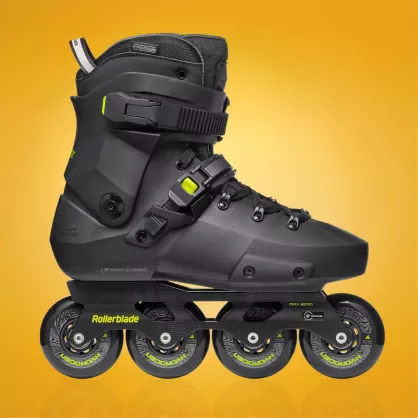
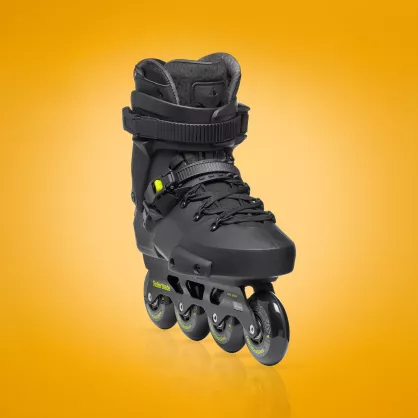
Rollerblade3 colours
Rollerblade Twister XT inline skates, black/lime
4×80 mm · 85A · ILQ-9 · 243 mm aluminium frame (255 mm from EU 44.5)
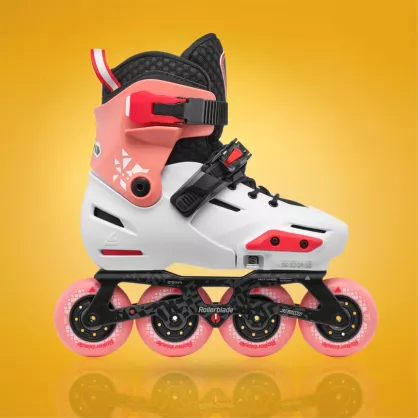
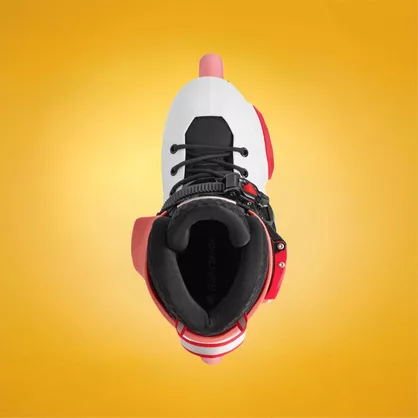
Rollerblade3 colours
Rollerblade Apex kids' skates (adjustable), platinum/coral
4×68–76 mm · 80A · SG7 · aluminium frame · adjustable
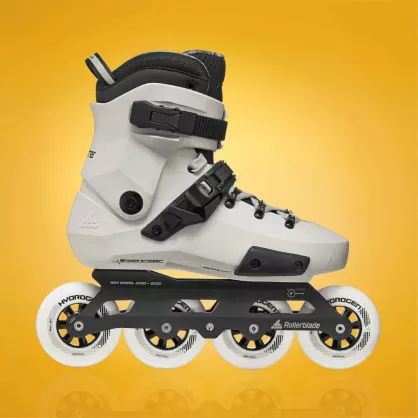
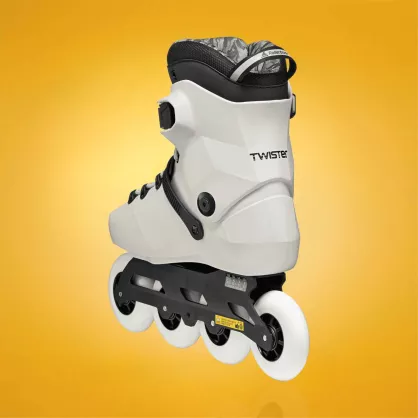
Rollerblade
Rollerblade Twister 90R inline skates
4×90 mm · 85A · ILQ-9 · 3&4WD aluminium frame 274 mm
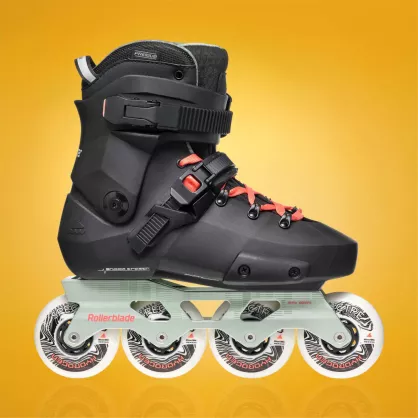
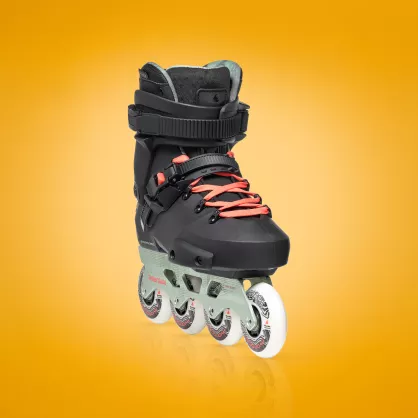
Rollerblade
Rollerblade Twister XT W inline skates, black/mint
4×80 mm · 85A · ILQ-9 · 243 mm aluminium frame
Read on
- GuideHow to choose inline skate wheels: diameter, hardness and rotationDiameter depends on the frame, hardness on the surface and your weight. Uses of 72–125 mm wheels, a rotation pattern and signs it is time for new wheels.
- GuideHow to choose ice skates: hockey, figure or recreationalHockey, figure or recreational: a comparison table, sizing rules, the first sharpening and a hollow depth matched to your weight and skating style.
- GuideHow to choose skating protective gear and a helmetPads are sized by knee, elbow and hand circumference, a helmet by head circumference. What to buy first, a fit test and sizes for kids.