Guide
How to choose skating protective gear and a helmet
Choose protective gear by the circumference of your knee, elbow and hand measured with a tailor’s tape measure, and a helmet by the circumference of your head above the eyebrows — not by height or age. On skates, the wrists take the most hits, so start with them. Pads should fit snugly and not rotate on the joint; a helmet should sit securely even before you fasten the strap.
What to protect first
The wrists are the most important. When you lose your balance, you instinctively put your hands out and your whole body weight lands on your palms. A wrist guard with a hard splint on the palm side absorbs the impact and lets your hand slide over the tarmac instead of stopping on it.
Build up your protection in this order:
- Wrist guards — falls onto the hands are the most common.
- Helmet — head injuries are rarer, but the most serious.
- Knee pads — protect you when you fall forwards and let you fall in a controlled way.
- Elbow pads — useful when you fall sideways and backwards.
The simplest option is to buy a set of three pairs and a helmet. This applies to adults too: an adult falls from a greater height and with more mass than a child.
Measuring circumferences
Pad sizes depend on circumferences, not height. You need a tailor’s tape measure and two minutes.
| Item | How to measure | How it should sit |
|---|---|---|
| Knee pads | knee circumference at the middle of the kneecap | the cap sits on the kneecap and does not slip when you bend your leg |
| Elbow pads | elbow circumference with the arm slightly bent | does not rotate when you bend your arm |
| Wrist guards | hand or wrist circumference, according to the manufacturer’s chart | splint on the palm side, fingers free |
| Helmet | head circumference about 1 cm above the eyebrows | level, does not move when you shake your head |
Compare the result with the size chart of the specific manufacturer, which we add to the product photos. Charts from different brands do not match one another, so one company’s size M does not necessarily correspond to another’s M.
Fitting pads
If you fall between two sizes, choose the smaller one. Pads should fit snugly, because a loose pad rotates at the moment of impact and exposes the joint. It is easy to check: fasten the pad and pull it hard to the side. It should not move.
Pay attention to three things:
- Left and right versions — contoured pads sit anatomically and move less.
- Straps — tighten them evenly, top and bottom; the velcro should hold along its whole length.
- The order you put them on — put wrist guards on last, because they make it harder to fasten the other pads and the buckles on your skates.
You will find sets for adults and kids in the skating protective gear section.
Helmet size and fit
Choose a helmet by your head circumference in centimetres and check the fit before fastening the strap. Run the tape measure about a centimetre above your eyebrows, above your ears and around the most prominent point at the back of your head.
- Put the helmet on level. The front edge should be two fingers above your eyebrows, not on the top of your head.
- Tighten the circumference adjuster until the helmet holds your head without pressing.
- Shake your head from side to side and forwards. The helmet must not move.
- Adjust the side straps so that they meet just below your ears.
- Fasten the chin strap. You should be able to fit one finger under it.
For skating, a skate-style helmet works best, with a deeper shell that covers the sides and back of the head lower down. A helmet like this will also do for riding a scooter, skateboarding and cycling. You will find models in the skating helmets section.
Protective gear and helmets for kids
Choose protection for kids the same way as for adults: by circumference, not age. Junior sets have their own size range, starting at XXXS.
Do not buy a size up for them to grow into. A pad that is too big slips down to the calf or forearm before the child touches the ground, and a helmet that is too big slides down over the eyes. If your child is between sizes, take the smaller set of pads, and choose a helmet whose range puts their head circumference roughly in the middle.
Children are more willing to wear protection they can put on themselves. Practise fastening it at home and check that the velcro straps do not scratch the skin in the crook of the elbow and knee.
When to replace it and how to look after it
Replace a helmet after any hard impact, even if there are no visible cracks. The foam inside deforms permanently and will not absorb energy the same way a second time.
Replace pads when the cap is cracked, the velcro no longer holds or the material has stretched so much that the pad slips. After skating, take them out of the bag and let them dry. Hand wash them in lukewarm water and dry them away from radiators; a washing machine and tumble dryer deform the caps and ruin the velcro.
If you are putting together a complete kit from scratch, also take a look at the guide which inline skates for beginners.
Quick answers
Which skating pads are the most important?
Wrist guards, because when you fall you instinctively put your hands out. Then a helmet, knee pads and elbow pads.
How do I choose the size of skating pads?
Measure your knee circumference at the middle of the kneecap and your elbow circumference with your arm slightly bent, then compare the results with the manufacturer’s chart. If you are between sizes, choose the smaller one.
How do I measure my head circumference for a helmet?
With a tailor’s tape measure, about 1 cm above the eyebrows, above the ears and around the most prominent point at the back of the head.
Is a bike helmet suitable for skating?
Yes, if it fits well and does not move on your head. A skate-style helmet covers the sides and back of the head better.
Should I buy bigger pads for my child so they last longer?
No. A pad that is too big slips when the child falls and does not protect the joint. Choose the size for their current measurements.
Models mentioned
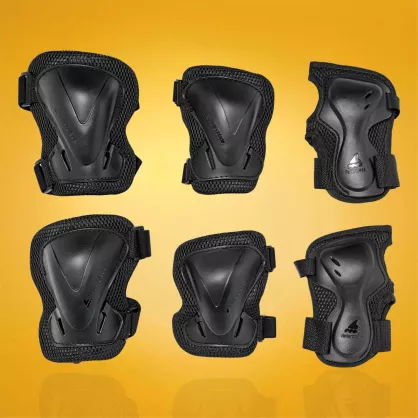
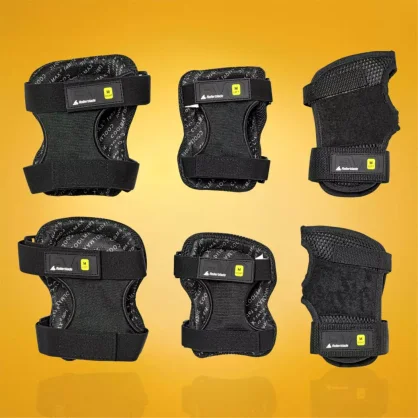
Rollerblade
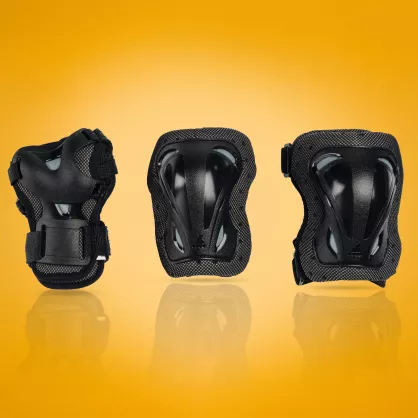
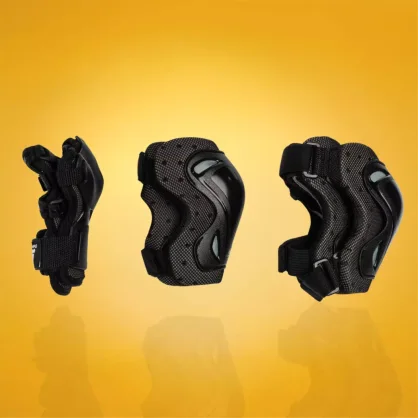
Rollerblade Evo Pro Gear 3-pack protective gear, black
wrist guards + elbow pads + knee pads · for adults
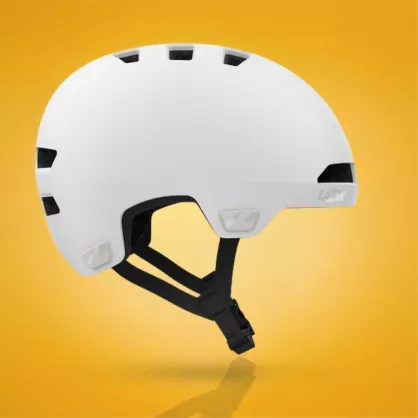
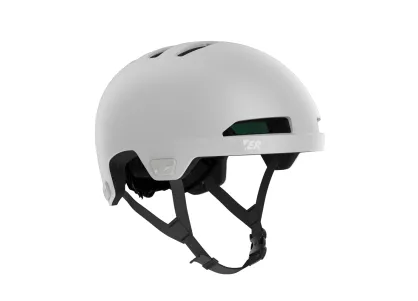
Lazer7 colours
Lazer Maze KinetiCore helmet, matte white
KinetiCore · TurnSys adjustment · 420 g (M)
Rollerblade2 colours
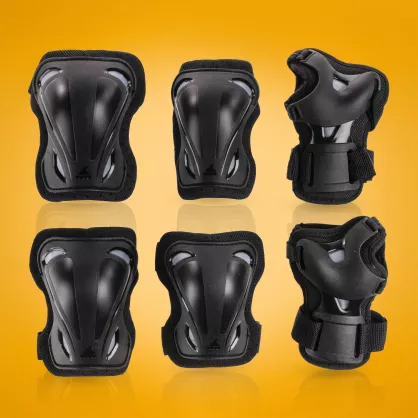
Rollerblade Skate Gear Junior 3-pack kids' protective gear, black
wrist guards + elbow pads + knee pads · kids' sizes
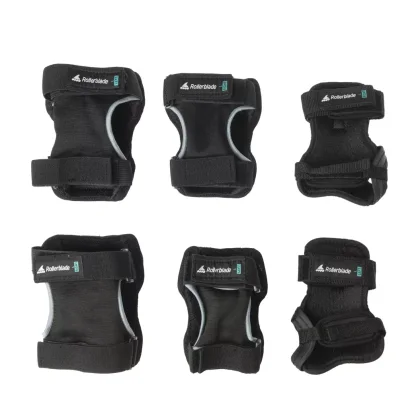
Rollerblade
Rollerblade Skate Gear 3-pack protective gear, black
wrist guards + elbow pads + knee pads · for adults
Read on
- GuideHow to choose inline skate wheels: diameter, hardness and rotationDiameter depends on the frame, hardness on the surface and your weight. Uses of 72–125 mm wheels, a rotation pattern and signs it is time for new wheels.
- GuideHow to choose ice skates: hockey, figure or recreationalHockey, figure or recreational: a comparison table, sizing rules, the first sharpening and a hollow depth matched to your weight and skating style.
- GuideHow to choose inline skate size: measuring your foot in millimetresMeasure your foot in millimetres and choose an insole 0–5 mm longer. Step-by-step measuring guide, dual sizes and adjustable kids’ skates.