
Guide
Urban or fitness skates: how they differ and which to choose
For learning to skate and for the city, choose urban skates with a hard boot: they hold the ankle better, are more manoeuvrable and most of their parts can be replaced. Fitness skates with a soft boot and bigger wheels are lighter, more breathable and more comfortable on smooth paths and long routes, but they require technique you have already mastered.
The differences at a glance
Urban and fitness skates differ above all in the boot, and only then in the frame and wheels. The boot determines how the skate holds the ankle joint, and therefore your balance and control.
| Feature | Urban skates (freeskate) | Fitness skates |
|---|---|---|
| Boot | hard shell with a removable liner | soft, ventilated |
| Ankle support | firm, including sideways | weaker, depends on the cuff |
| Frame | short, usually bolted on and replaceable | longer, often permanently riveted |
| Wheels | usually 4 × 80 mm | 80–90 mm, in training models 100–110 mm |
| Manoeuvrability | high | lower |
| Comfort on a long route | lower: the boot is heavier and warmer | higher |
| Replaceable parts | frame, buckles, liner, wheels | mainly wheels and bearings |
| Best for | learning, the city, slalom, jumps | smooth paths, distance, fitness training |
Boot: hard vs soft
A hard boot is better for learning, because it keeps the ankle aligned. In a soft boot, the ankle joint moves sideways: the beginner then stands on the inside edges of the wheels, the skates splay apart and it is hard to position the foot for braking. A stiff shell with a cuff buckle keeps the foot straight, even when the muscles cannot yet keep up.
A soft boot wins at the first try-on. It is lighter, keeps the foot cooler and feels well fitted straight away. That is why many people choose it in the shop and regret it on the tarmac. A hard boot needs two or three sessions before the liner moulds to the foot.
The second difference is durability. In a hard boot you can replace the liner, buckles and frame, so the skates outlast several sets of wheels. A soft boot stretches after a few seasons and loses its support, and that cannot be repaired.
Frame and wheels
A short frame with four 80 mm wheels, typical of urban skates, lets you turn tightly and react quickly to obstacles. A longer frame with larger wheels tracks more steadily in a straight line and at higher speed, but changes direction more slowly.
A larger wheel holds its speed longer and rolls more smoothly over cracks in the tarmac. At the same time, it raises the centre of gravity and lengthens the braking distance, which gets in the way when you are just starting to learn.
In urban skates the frame is usually bolted on, so it can be replaced over time, for example with a model for three 110 mm wheels. In many fitness skates the frame is riveted to the boot and stays as you bought it.
When urban skates are better
Choose urban skates if even one of the following applies to you:
- you are just learning to skate or coming back after many years,
- you skate on pavements, paving stones and pedestrian crossings,
- you want to develop your technique: skating backwards, slalom, jumps,
- you are heavier and need a design that does not flex,
- you want equipment in which parts can be replaced.
This group includes the Rollerblade Twister XT and RB, FR Skates FR1, FR2 and NEO, and the Seba E3.
When fitness skates are better
Choose fitness skates if you skate confidently, can brake and do most of your kilometres on smooth paths. On routes of 30 km and more, a lighter boot, better ventilation and bigger wheels make a real difference to how tired you get.
For your first season in this group, go for 80–84 mm wheels. Leave models with 100–110 mm wheels until braking at higher speed is no longer a problem. Examples from our range are the Rollerblade Macroblade and K2 Alexis.
Common misconceptions
“Urban skates are for advanced skaters.” It is the other way round: a stable boot helps most when technique is weakest.
“Bigger wheels mean better skates.” Bigger wheels are faster on the straight, not better. In the city, manoeuvrability and a short braking distance matter more.
“A soft boot is more comfortable.” In the shop, yes. After an hour of skating, the more comfortable boot is the one in which the foot does not have to hold the ankle up on its own.
How to decide
Answer two questions: where will you do most of your kilometres, and can you already brake? If the answers are “the city” or “not yet”, choose urban skates. If they are “smooth paths” and “yes”, fitness skates will be more comfortable.
For mixed skating, urban skates are the safer choice: you can easily skate 20 km on a path in them, while a kerb will always be an obstacle in fitness skates. Once you have chosen the type, measure your foot following the instructions in how to choose inline skate size or enter its length in the Skate finder.
Quick answers
Can you skate long routes on urban skates?
Yes, 20–30 km on 80 mm wheels is a normal distance. For longer, smooth routes, bigger wheels are more comfortable — that means fitness skates or a different frame on urban skates.
Which skates are better for an adult beginner?
Urban skates with a hard boot and 80 mm wheels. A stable ankle shortens the time it takes to learn balance and braking.
Are fitness skates faster?
On the straight, yes, if they have bigger wheels: 90 mm holds speed longer than 80 mm. In the city, the advantage comes from manoeuvrability, not top speed.
Can you replace the frame on fitness skates?
Usually not, because in many models it is riveted to the boot. On urban skates the frame is usually bolted on and replaceable.
What do hardboot and softboot mean?
A hardboot is a plastic shell with a removable inner boot. A softboot is a soft boot stiffened by a rigid chassis and a cuff.
Models mentioned
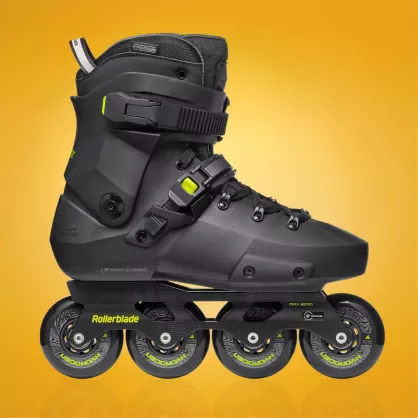
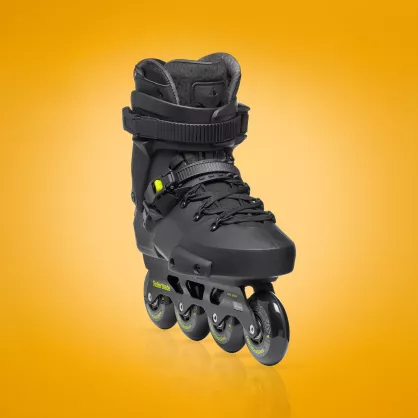
Rollerblade3 colours
Rollerblade Twister XT inline skates, black/lime
4×80 mm · 85A · ILQ-9 · 243 mm aluminium frame (255 mm from EU 44.5)
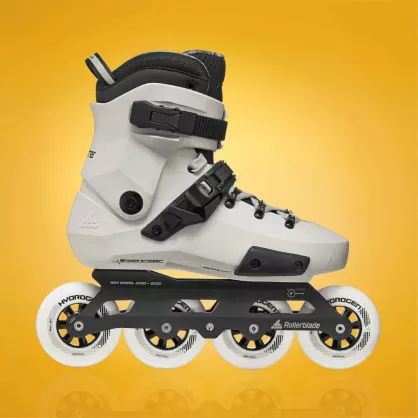
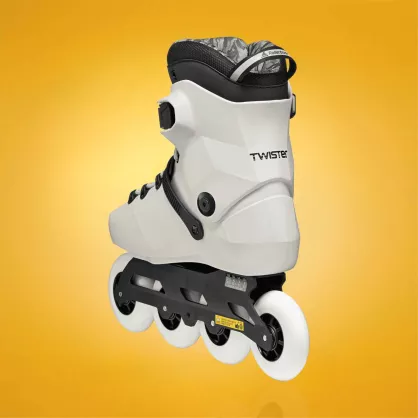
Rollerblade
Rollerblade Twister 90R inline skates
4×90 mm · 85A · ILQ-9 · 3&4WD aluminium frame 274 mm
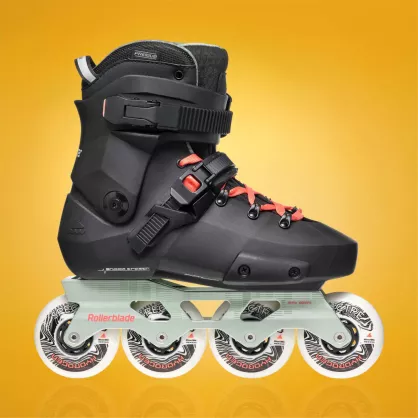
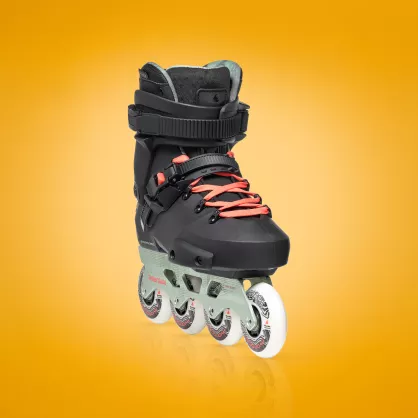
Rollerblade
Rollerblade Twister XT W inline skates, black/mint
4×80 mm · 85A · ILQ-9 · 243 mm aluminium frame
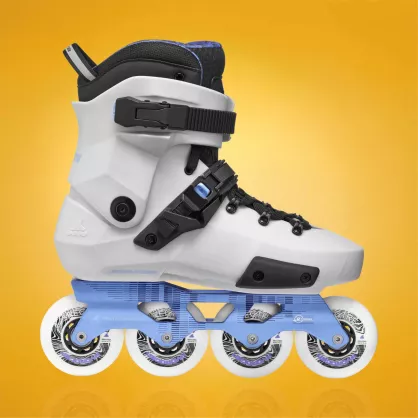
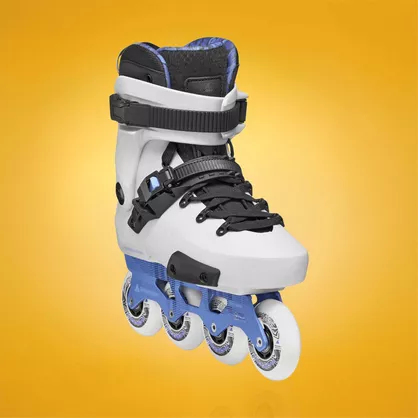
Rollerblade3 colours
Rollerblade Twister XT inline skates, grey/sky blue
4×80 mm · 85A · ILQ-9 · 243 mm aluminium frame
Read on
- GuideHow to choose inline skate wheels: diameter, hardness and rotationDiameter depends on the frame, hardness on the surface and your weight. Uses of 72–125 mm wheels, a rotation pattern and signs it is time for new wheels.
- GuideHow to choose ice skates: hockey, figure or recreationalHockey, figure or recreational: a comparison table, sizing rules, the first sharpening and a hollow depth matched to your weight and skating style.
- GuideHow to choose skating protective gear and a helmetPads are sized by knee, elbow and hand circumference, a helmet by head circumference. What to buy first, a fit test and sizes for kids.