
Guide
Which inline skates for beginners: first skates for adults
For your first adult skates, choose a model that holds the ankle firmly and has 80 mm polyurethane wheels, branded bearings and a brake. Urban skates with a hard boot are the easiest to learn on. Choose the size by foot length in millimetres, and budget for wrist guards, knee pads, elbow pads and a helmet straight away.
Four things to check
Judge your first skates by four elements. Colour, the number of buckles and the bearing name only matter once these four are right.
| Element | What to look for | Why |
|---|---|---|
| Boot | hard shell or a stiff cuff with a buckle | balance starts at the ankle joint |
| Wheels | 80 mm, polyurethane, hardness 82A–85A | stable, predictable, fast enough |
| Brake | included or available to buy | heel braking is the first stopping technique |
| Frame | stiff, bolted to the boot | does not flex, lets you replace parts |
Ankle support
The most important thing is a boot that does not let the ankle collapse sideways. You can check this in a minute: fasten the skate, stand on it and try to tilt your ankle inwards. The cuff should put up clear resistance.
Support comes from three fastening elements. The cuff buckle stabilises the leg above the ankle, the 45° buckle or strap over the instep presses the heel into the back of the boot, and the laces fit the boot along the length of the foot. If your heel lifts when you bend your knees with all three fastened, the skate is too big or too wide.
That is why we recommend skates with a hard shell to start with. In a soft fitness boot, the ankle moves sideways, a beginner ends up on the inside edges of the wheels and every metre takes more effort. A detailed comparison of the two designs is in the guide urban or fitness skates.
80 mm wheels and a brake
80 mm wheels are a sensible middle ground for learning. Smaller ones roll worse over uneven tarmac. Larger ones raise the centre of gravity, pick up speed faster and lengthen the braking distance — and braking is the first thing you learn.
Fit the heel brake from your very first session, even if with urban skates it comes separately in the box or has to be bought separately. It lets you stop before you have mastered the T-stop. You can take it off when you no longer need it.
Leave three-wheel skates with 110 mm wheels for later. They are fast and tall, so they forgive fewer mistakes.
Budget: what you are paying for
The price difference between models comes from specific parts, not just the brand:
- Frame — aluminium is stiffer and more durable than composite.
- Liner — a removable one can be dried, washed and replaced; in cheaper models it is sometimes sewn in permanently.
- Wheels and bearings — a better polyurethane compound wears more slowly and grips better in the wet.
- Replaceability — in more expensive models you can replace the buckles, frame and liner; in cheaper ones not necessarily.
You do not need the top model in the range. Entry-level skates from a manufacturer that specialises in skates have standard part sizes, so you can upgrade the wheels and bearings later, once they wear out. Current prices are in the skates for beginners section.
What to avoid
The biggest mistake is skates from a supermarket or the toy section. You can recognise them by three features:
- a plastic frame that flexes under an adult’s weight,
- wheels made of hard plastic instead of polyurethane — they slip on tarmac and do not absorb vibration,
- bearings with no markings at all and no spare parts.
It is harder to keep your balance on skates like these than on decent equipment, so the beginner decides that skating is not for them. Also avoid adjustable “whole family” skates: the adjustment comes at the expense of boot stiffness.
The second common mistake is copying the size from your shoes. Skates are sized by foot length in millimetres — instructions are in the guide how to choose inline skate size.
First kit
Add a set of protective gear and a helmet to your skates. When you are learning, falls are a certainty, and it is usually the wrists that take the hits, because you instinctively put your hands out.
- Wrist guards — the most important.
- Knee pads — useful when you fall forwards.
- Helmet — protects against the most serious injury.
- Elbow pads — complete the set.
How to choose sizes is explained in the guide how to choose protective gear and a helmet. Add thin socks that are higher than the cuff; cotton trainer socks end in a blister on the ankle.
First sessions
Start on a flat, empty square, not on a bike path. Bend your knees, shift your weight to the middle of your feet and keep your hands in front of you. Before you pick up speed, learn two things: braking with your heel and falling forwards, onto your knee pads and wrist guards.
The plan for the first few hours is short:
- Shifting your weight from foot to foot on the spot, ideally on grass or next to a railing.
- Skating in a straight line with short pushes to the side, not backwards.
- Heel braking to a complete stop.
- A gentle turn in both directions.
If you would rather choose skates with someone who asks the right questions, come for a fitting at our shop in Poznań or Wrocław — no appointment needed.
Quick answers
Which wheels for beginner skates?
80 mm polyurethane wheels with a hardness of 82A–85A. They are stable and predictable, and at the same time fast enough for recreational routes.
Can my first skates be second-hand?
They can, if the boot is not worn out, the frame has no cracks and parts can still be bought. Treat the wheels and bearings as parts to be replaced.
Should a beginner buy three-wheel skates?
Better not. 110 mm wheels are taller and faster, so it is harder to brake and keep your balance on them.
Are supermarket skates good enough to try skating?
They usually put people off. A soft boot, a plastic frame and plastic wheels make balancing harder than a lack of skill does.
What should I buy with my first skates?
A set of wrist guards, knee pads and elbow pads, a helmet and thin, high socks. At the start, a heel brake is also useful if one is not included.
Models mentioned
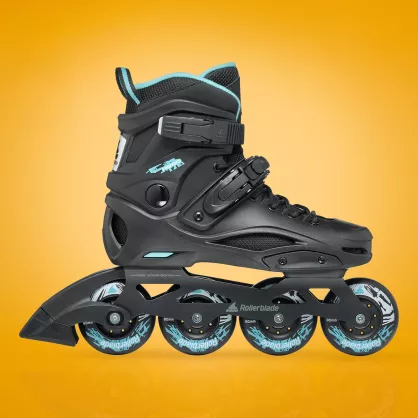
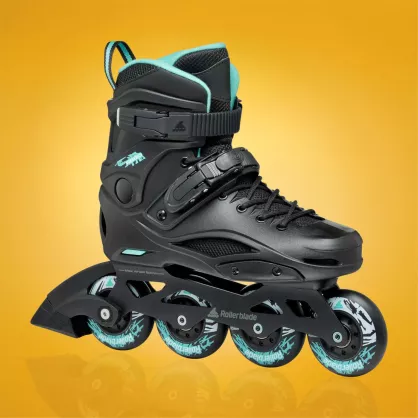
Rollerblade
Rollerblade RB 80 W inline skates, black/sky blue
4×80 mm · 82A · SG7 · 243 mm aluminium frame
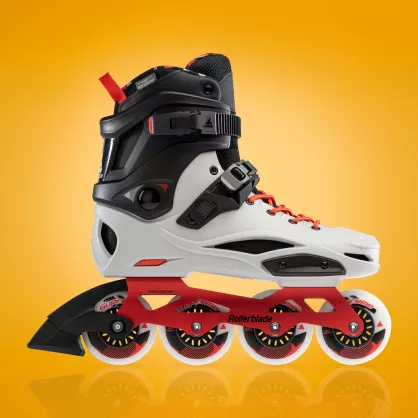
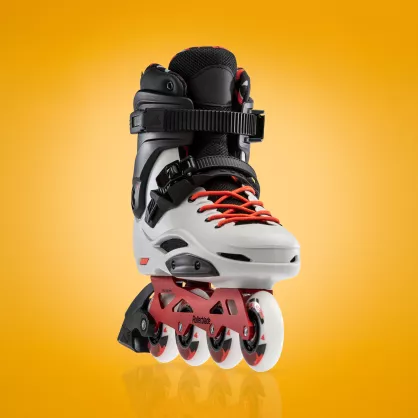
Rollerblade
Rollerblade RB Pro X inline skates
4×80 mm · 85A · ILQ-7 · 243 mm aluminium frame
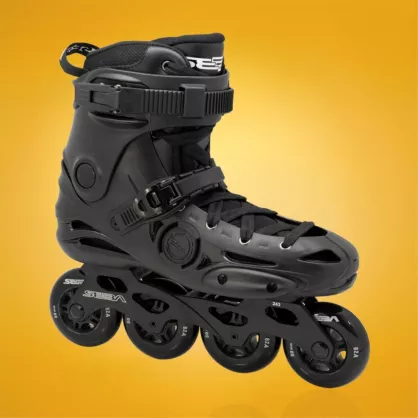
Seba
Seba E3 80 Premium inline skates, black
4×80 mm · 82A · ABEC 9 · 243 mm aluminium frame
Read on
- GuideHow to choose inline skate wheels: diameter, hardness and rotationDiameter depends on the frame, hardness on the surface and your weight. Uses of 72–125 mm wheels, a rotation pattern and signs it is time for new wheels.
- GuideHow to choose ice skates: hockey, figure or recreationalHockey, figure or recreational: a comparison table, sizing rules, the first sharpening and a hollow depth matched to your weight and skating style.
- GuideHow to choose skating protective gear and a helmetPads are sized by knee, elbow and hand circumference, a helmet by head circumference. What to buy first, a fit test and sizes for kids.